The decision on crank arm length is often an over looked factor in bicycle setup. When purchasing a new bicycle, crank length is never really considered, however, it can make a significant difference to your overall cycling performance and pedal efficiency.
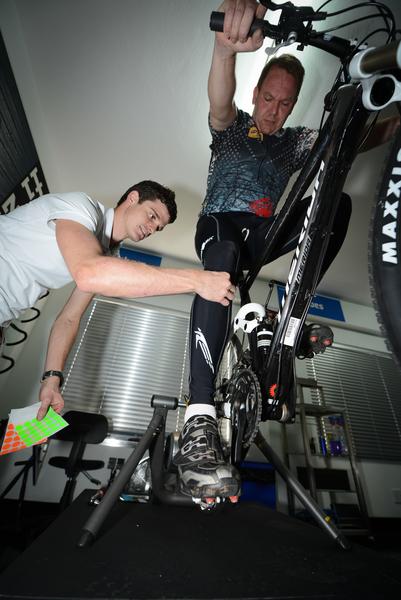 Image credit: Zoon Cronje
[blockquote]First learn to spin a small gear. Then get strong enough to turn a big gear. Then get fit enough to spin a big gear.[/blockquote]
So what is best for you?
The first thing that should be taken into consideration is the nature of riding and the terrain you will be attempting to conquer. Will you be riding mountainous or flat terrain? Will you be looking for short sharp accelerations, or longer sustained efforts? Are you a rider that prefers to “mash” a heavy gear, or alternatively use cadence to spin over tough terrain? After reflection on all previous factors, additional aspects such as leg length, leg proportions, foot length and flexibility should also be taken into account.
“Cranking it up”
Most crank manufacturers only make a limited range of crank lengths. For road use the three most common lengths are 170mm, 172.5mm and 175mm. On the mountain bike there is a choice between 170mm and 175mm. However, there are extreme lengths ranging between 180mm and 190mm (albeit uncommonly).
The shorter 170mm crank length can help with spinning to maintain a higher cadence, and minimise the chance of a ‘messy’ or untidy pedal stroke. A longer crank arm must progress further past TDC (top dead centre/ 12 o’clock in the pedal stroke) than a shorter crank arm before the rider can apply the same mechanical force to it. Therefore, a shorter crank in some cases may be the more economical approach when making this selection. A longer 175mm crank though, can improve torque output for steeper hill climbing but at the same time affect ground clearance when cornering and pedalling through rocky off road terrain.
Ultimately, a longer crank length does not necessarily mean more power. At first glance one may think more leverage = more power. It is however overlooked that greater leverage or crank length will create more extension at the bottom of the pedal stroke, with the crank arm at 6 o’clock. But this increased length will also result in an increased bend in the knee at the top of the pedal stroke at 12 o’clock or top dead centre in the crank arm. Therefore, longer crank length can result in a potential increase in knee problems as excessive flexing in the knee will cause greater shear force on the knee (when the upper leg pushes extreme force onto the knee cap).
As a point of interest try the following link to determine which crank length will be best suited to your specific inseam measurement: Optimum Bicycle Crank Length.
Some constraints to experimenting and ‘feeling’ which particular crank length works best for you is the cost of this exercise, and the time required for your body to adapt to the new equipment. Obviously, purchasing new cranks every time to chop and change between different lengths can become a costly affair. A new crank length should be tested over different terrains for a minimum period of three months to allow the muscle groups to adjust to the new position.
In summary, crank length is one of the many aspects to bike setup which can influence your cycling for the better if the proper steps are taken to ensure you are using the correct equipment.



I don't know, if you see the hip joint as the pivot point, then 5mm variance in crank length vs the variance of 100mm in Femur length seems trivial for different rider lengths. The taller guy would normally also have longer feet, that displaces his ancle joint (the other pivot) further away from the pedal center point.