To reach your fitness goals and maintain them, you need to train smarter, not harder and this can be achieved by understanding your heart. Your “maximum heart rate” is the maximum number of times your heart beats in one minute. To calculate an average reading of your max heart rate, take the number 220 for men or 226 for women and minus your age. For Example 226 – 30 = 196; a 30 year old woman’s max heart rate is 196 beats per minute.
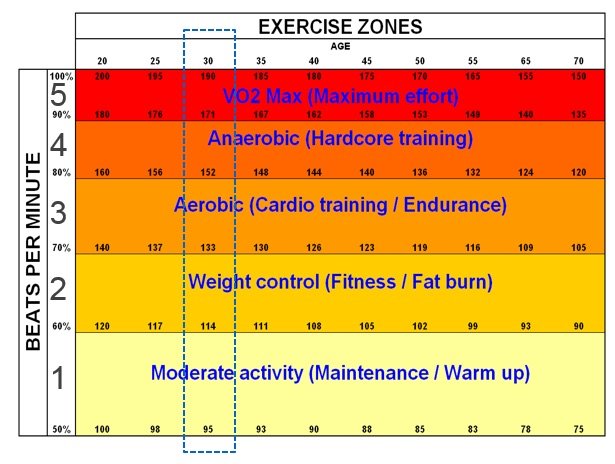
Once you have your max heart rate, you can calculate your unique heart rate zones. These will help you determine where you need to keep your heart rate while training. The graph below shows you the different heart rate zones labelled 1 to 5.
If you don’t have access to a table indicating your zones, you can calculate them by working out the different percentages using your max heart rate. This will give you a range in which you need to keep your heart rate in. For Instance Zone 3 is 70% to 80% of your max heart rate. So 70% = 137 and 80% = 157. This means that in order to stay in zone 3 your heart rate needs to be between 137 and 157 beats per minute.
Once you understand zones, you need to understand what they mean to you so you can train within them. This is important because each person is exercising for a different goal, some want to lose weight and others may want to increase their fitness level. You need to train in the correct zone in order to achieve your goals and keep motivated.
Zone 1 (heart rate is between 50 to 60% of your max heart rate) is a beginner’s level of aerobic training and consists of moderate activity or a warm up. You should be feeling relaxed, warming up at an easy pace and your breathing should be rhythmic. If your goal is to lose weight, you won’t achieve it in zone 1. You need to be exercising more vigorously to increase your heart rate.
Zone 2 (60-70%) is your weight control zone. You should be working out in a comfortable pace where you have slightly deeper breaths but can still have a conversation. If you are looking to lose weight, you should make sure your heart rate is in zone 2.
Zone 3 (70-80%) is your aerobic zone for those whose goals are to increase their fitness or cardio ability. You should be working out at a moderate pace and it should be more difficult to hold conversation. This will increase your cardio ability and improve your aerobic capacity.
Zone 4 (80-90%) is your anaerobic zone for hard core training. You will be working out at a fast pace and feel a bit uncomfortable. Your breathing will begin to feel a bit forceful but you will develop improved anaerobic capacity, increased strength and improved speed.
Zone 5 (90-100%) is your maximum effort zone. You should be sprinting as fast as you can but you won’t be able to sustain your pace and effort for too long. Your breathing will be laboured but you will develop muscular endurance and increased power when reaching this zone in your work outs.
If you aren’t wearing a heart rate monitor while you train you won’t know what your heart is doing and in which zone you are training in. Garmin’s range of heart rate monitors have 2 electrodes on the inside of the strap and these electrodes press against your skin and pick up the pulses made by your heart beating. This information is then transmitter to your Garmin fitness watch using ANT+ technology.
Garmin has a range of fitness watches, ranging from entry level to advanced. Visit the http://www.garmin.co.za/onto-fitness.php to find a fitness watch that suites your needs.





 :D )
:D )


this formula doesn't correspond to the scientific test, more than 10 beats higher. Whereas the articles formula is spot on with the scientific test.