The Westfalia Bike Carrier is a towbar mounted bicycle carrier with variations for carrying two or three bikes.
Westfalia is a long-established German company. It is notable for inventing the fixed-ball type towbar that this bike rack now attaches. For local support, Westfalia bike racks are distributed within South Africa by Positive Sports Solutions.
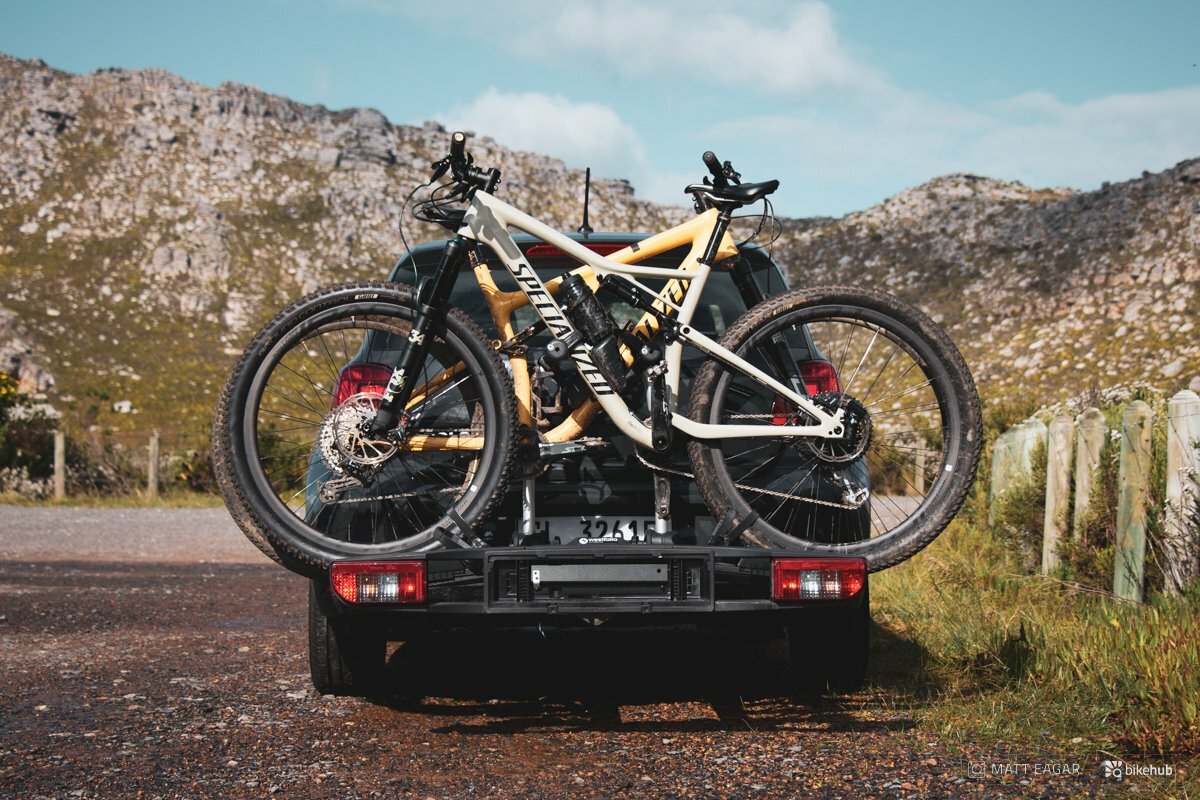
We tested the Westfalia 3 Bike Carrier. If you’re looking for other reviews, it appears to be marketed overseas as the Westfalia Bikelander (if part numbers are to be trusted). The Westfalia 3 bike rack is rated to carry up to 90 kilograms (at 30 kg per bicycle) making it suitable for heavier e-bikes. Its own weight is 19 kilograms making it reasonably movable by larger humans when detached from a vehicle.
Installation and Storage
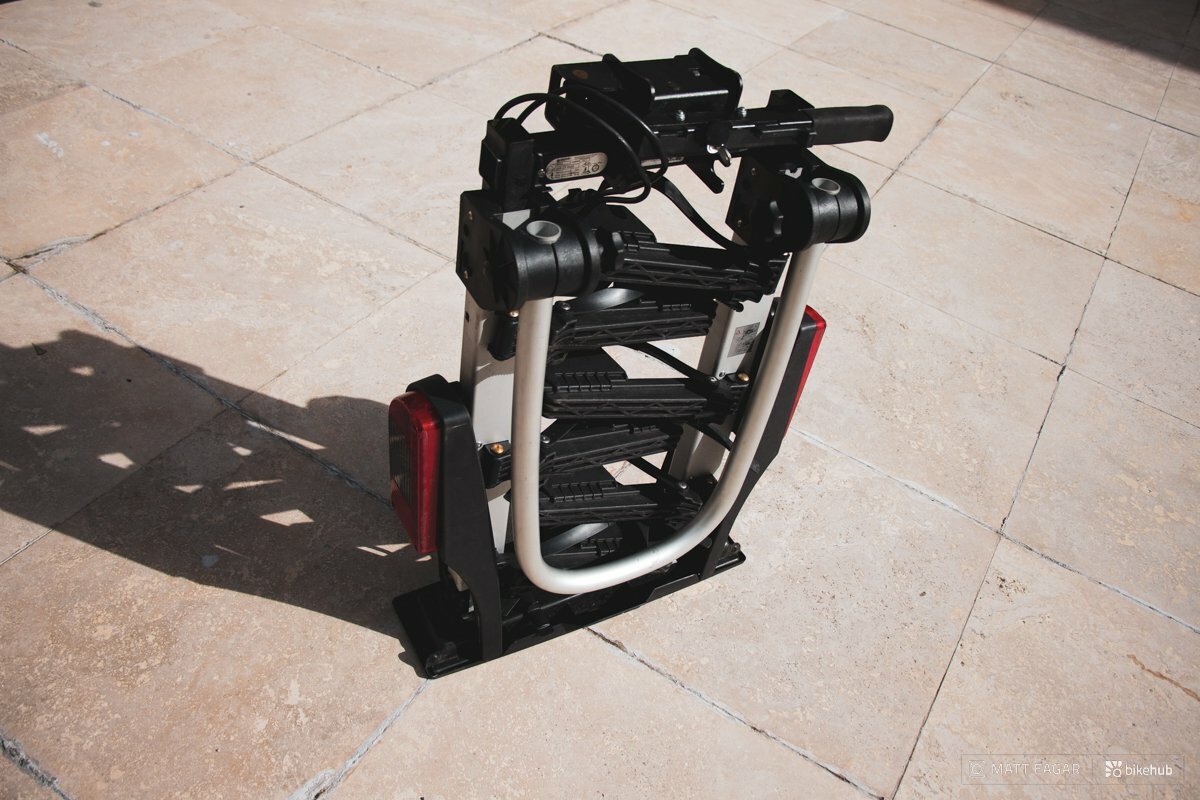
The Westfalia’s appendages fold up smartly (without tools) to improve manoeuvrable and significantly reduce storage space. It is in this form that the carrier arrives, assembled in its box and ready to be fitted to your car.
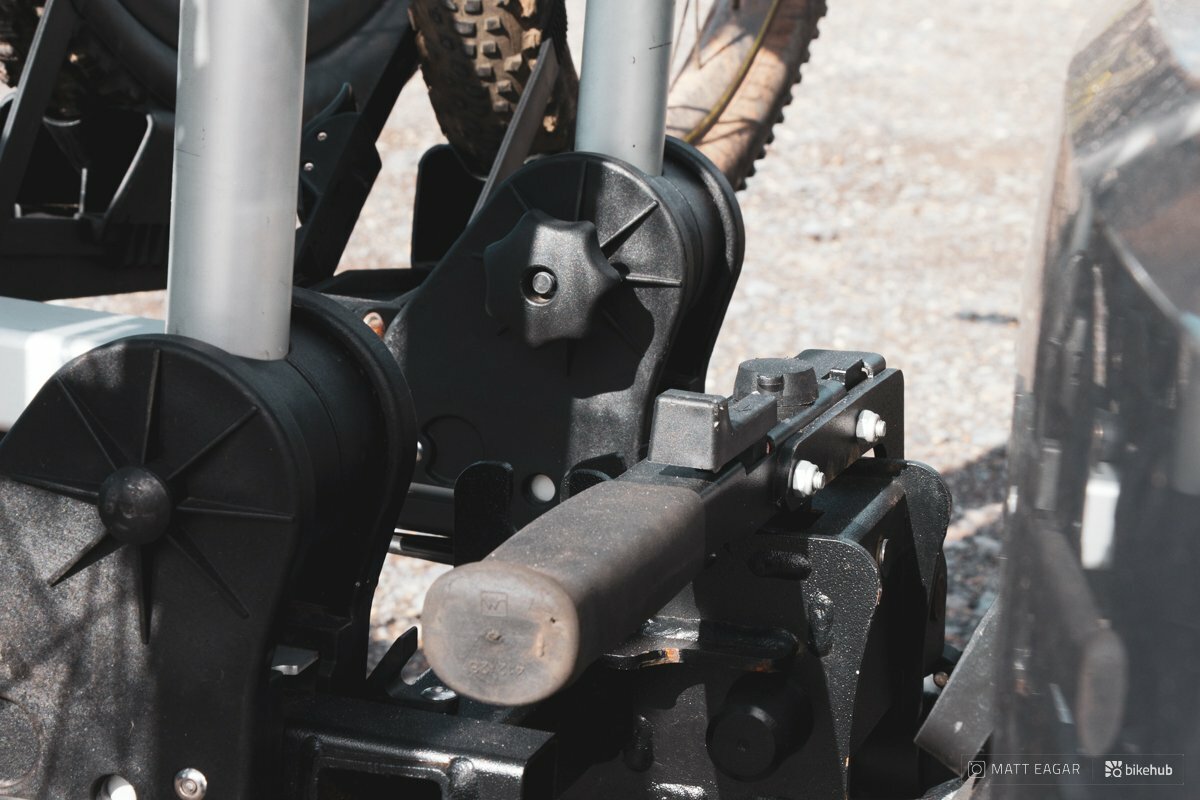
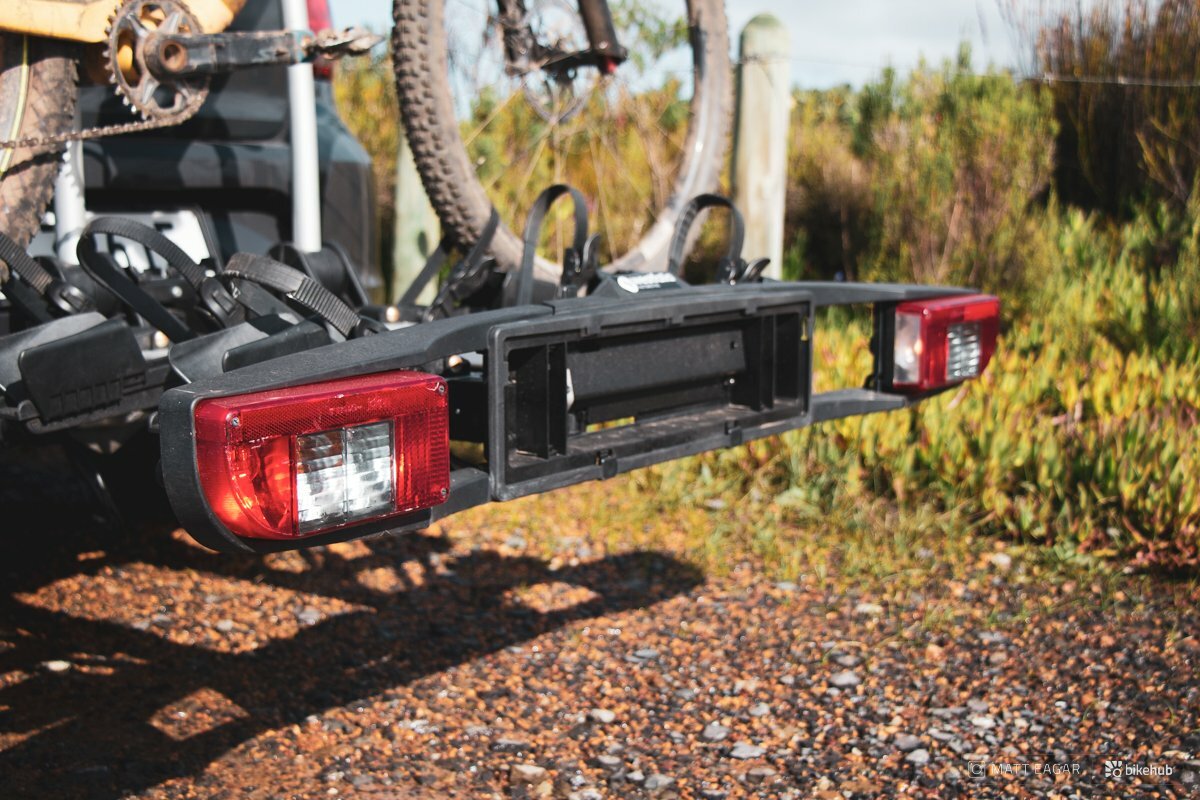
The installation is straightforward. It attaches to the towbar with a levered clamp holding it firmly in place. The clamp mechanism has a built-in lock to secure it in place and offer some resistance against opportunist thieves. Then you can connect the electrical plug, raise the mounting bracket (tighten it in place), fold out the rear light clusters, and flip open the wheel holders which click into place. And the Westfalia is ready for action.
A super convenient feature is that The Westfalia can fold forward with bikes fitted to allow for access into the back of the car.
It is also worth noting that the Westfalia is approximately 800mm long. Perhaps it is because I am familiar with a relatively compact car (VW Polo) but I became very conscious of the rack poking precariously out of parking bays.
Yes, it’s a marketing video but the nice man does do a good job at explaining the finer details of the Westfalia’s operation.
Bike Fitment
Bikes are held in place at the wheels and on the frame. An arm with pincer-like clamps grasp the bicycle frame and u-shaped mounting tube. While wheel holders and straps secure the base of the bike.
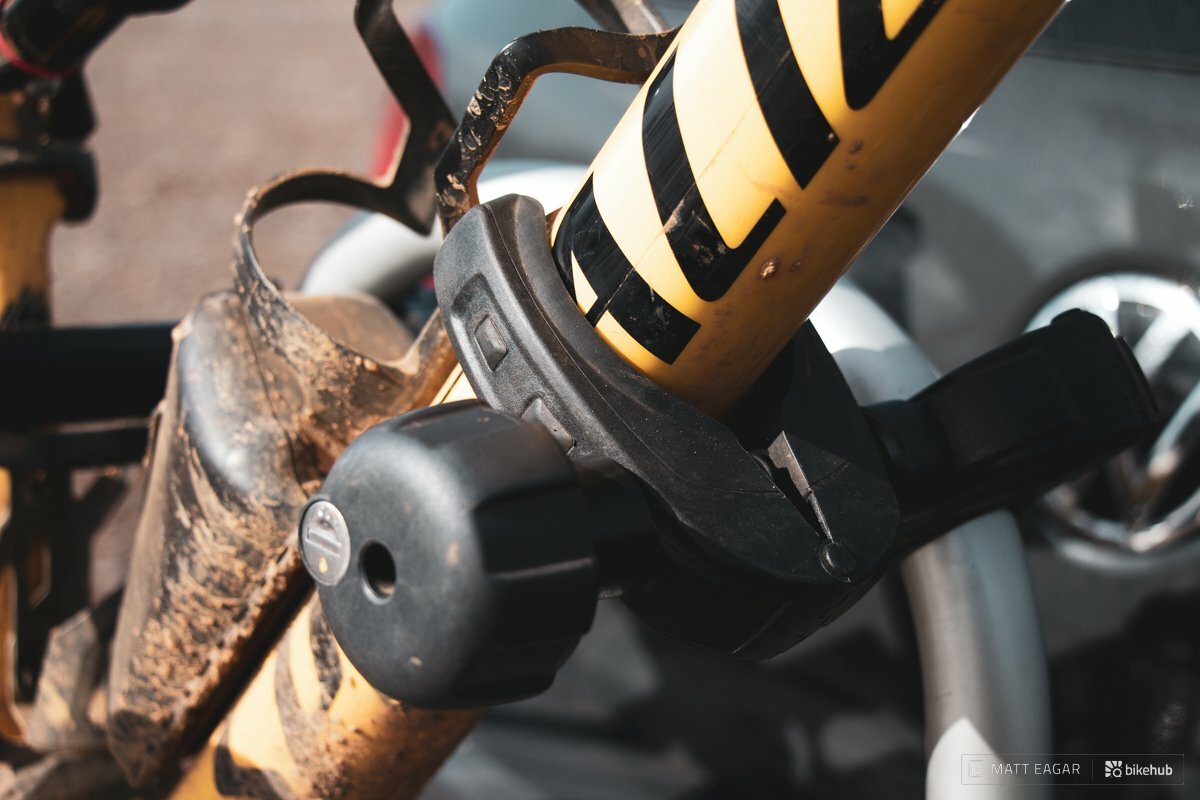
The arms have clamps on both ends. There is a clamp that mounts to the bike rack and a clamp for the bicycle frame. The arm for the third (and outer most) bike clamps to the middle bike and not to the bike rack. Each arm has a lock on the bike clamp to ensure that they remain closed during transport and to prevent easy access to the bikes.
The two clamps on the arms are part of the same system and do not work independently of each other. To open the bike rack clamp, you must close the bike frame clamp on the other end of the arm and vice versa. This means that while attaching the arm to the bike the clamp on the bike rack end can move freely. This can be helpful for easy adjustment but is also frustrating when awkwardly balancing bikes during fitment while the arm keeps moving out of place without a fixed attachment to the bike rack.
Another downside is that the clamp does not remain in place when you remove a bike. Meaning that you can’t simply return knowing that the clamps are already in the best position to load your bikes.
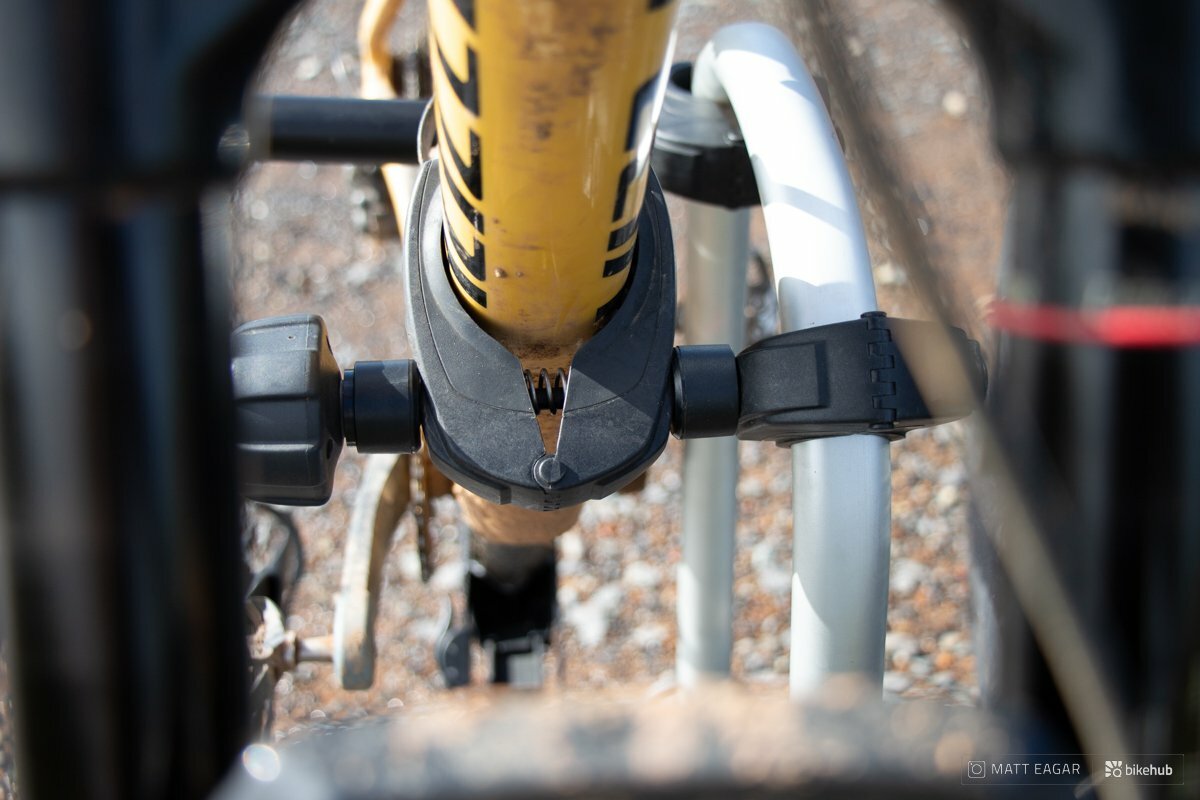
This minor niggle aside, the clamps feel very secure when in place and offer a reassured grip to the bicycle frame. The frame clamp can only open so much which limits the size of tubing it can clamp to. Don’t expect to fit the clamp around oversized or oddly shaped tubes, stick rather to the seatpost or thinner top tubes.
The wheels go into holders that fit snuggly with the tyres. The holders can slide back and forth along a rail to adjust a bike’s wheelbase. A strap runs through each wheel and over the rim to secure it in place. Tightening and releasing the strap is a simple task.
If you ride a large modern trail, enduro or downhill bike it is worth noting that the wheel holders only extend so far. The longest bike I tested the rack with was 1227 mm and that was starting to edge over the wheel holders. Although I did not test it, there might be issues with bikes longer than 1300 mm wheelbase. Likewise, I’m unsure whether Plus-sized mountain bike tyres fit into the wheel holder cups.
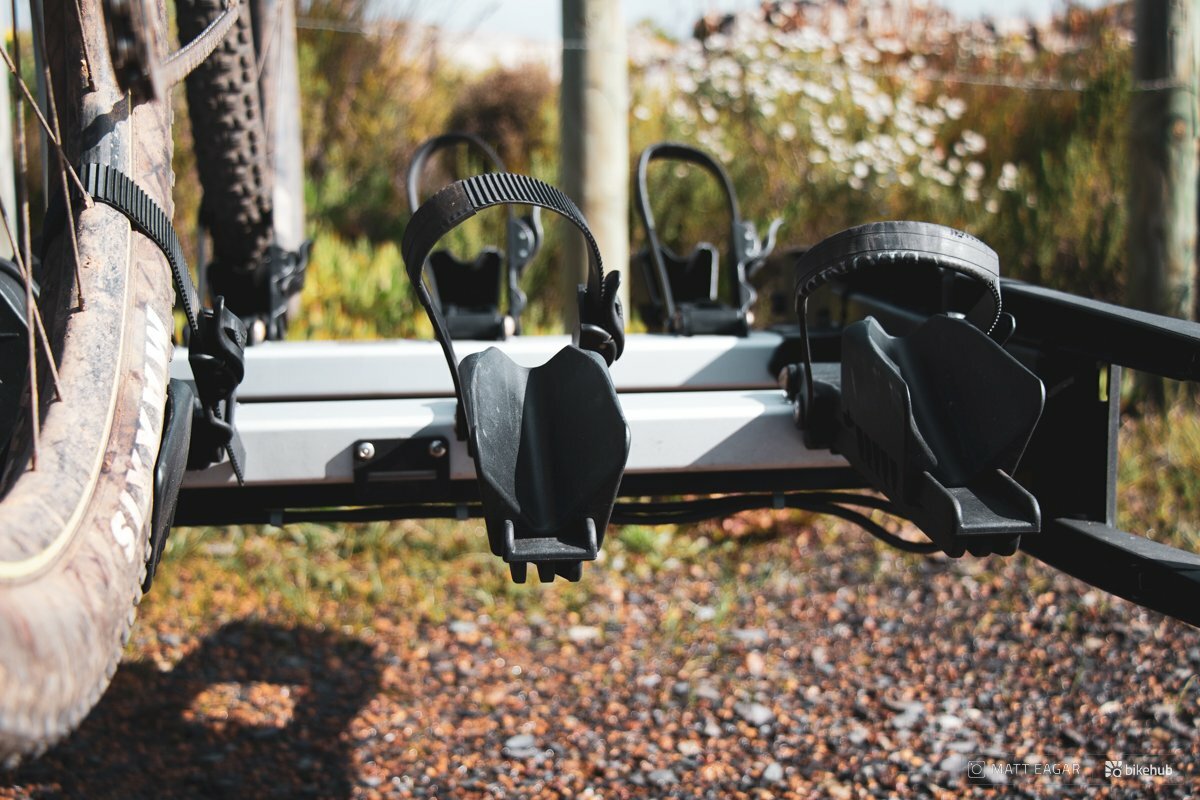
No matter the bike rack it is always a puzzle getting bicycles to fit without contact. The Westfalia offers a reasonable gap between the bikes which easily accommodates modern boost axle sizing on mountain bikes. The wheel holders also place the bikes at slightly different angles to allow for wider rear ends. While the spacing is good, the arm attachment on all bike racks of this design is a bit like playing pick-up sticks. Thankfully, on the Westfalia, the third arm for the outer most bike (that fastens to the middle bike) does save you from the impossible task of sliding it through the mess of the two fitted bike frames to reach the support tube.
Pricing
The Westfalia 3-bike carrier retails for around R15,999 with the 2-bike option at R13,999. If you’re looking to carry normal bikes, this places the Westfalia squarely in the price bracket of other premium European competitors. But should you be looking for something to specifically carry heavier and bulkier e-bike loads, then Westfalia does dip considerably below the pricing of its rivals.
Conclusion
The Westfalia 3-bike carrier is a well-rounded, sturdy towbar bicycle rack. The star feature is the weight limit means that it is capable of holding heavy ebikes. The fitment is a breeze and it folds up into a compact shape for storage. In terms of fitment, there is generous spacing between bikes, the wheel mounts are easy to operate but the arm clamps can be a little fiddly in a rush.




Those prices, just make my eyes water ????